Wednesday, May 6, 2015
Teen girls learn to code in Ghana
Image
A recent CNN article describes a multitude of teen girls in Ghana who are learning how to code on the upper level of a local mosque while their parents pray below. In addition to adding to the number of individuals in the tech world who know how to code, the program was designed in part to show the community how valuable it is to educate girls. Each class serves about 50 female students, who learn to code and run a blog called "Slum Voices."
I really enjoyed reading this article, and loved the way this technology and information was able to give these girls a voice and an outlet that they previously hadn't had. Teaching technology is vitally important in today's world, and allowing students to feel connected to more of the world is beneficial to their learning. When students feel that their opinions and thoughts have value, they are more willing to share and likely will have more of a desire to learn.
Here is a link to the original article:
Teen girls code their way to a brighter future
iPads in LA Schools
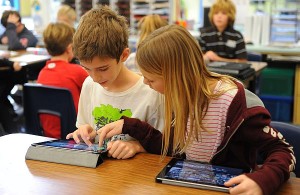
Slate writer Lily Hay Newman reported that LA public school district has chosen to shut down its multimillion dollar iPad program, and is also seeking a refund from Apple. The program, which was started with the intention of giving every child access to these high quality devices, fell short of expectations in the eyes of school officials.
Image
While reading this article, titled LA School District Terminates iPad Program and Seeks Refund from Apple, I found myself wondering why the program did not meet the expectations of the program's initiators. I feel as though the school district had very ambitious results for these iPads to generate, and perhaps while the technology was now there where it had not been in the past, it was not being utilized properly. In my opinion, it is the quality of the technology being used, rather than the quantity. It does not necessarily surprise me that the program was unsuccessful, as it was a program based on simply giving students access to iPads (a noble goal and something worthwhile), rather than a program directed at educating teachers on how to use these iPads effectively in their classrooms.
Here is a link to the article:
LA school district terminates iPad program
Is Memorization Best?
I read an article on NPRs website titled Would Doctors Be Better if They Didn't Have to Memorize? which discussed the idea that the way medical students are educated may be out of date, and not in like with technological advances. The author argued that while memorization of certain concepts is beneficial, medical students should be educated in teams - as that is how they will be working in the future, and focus on how to combat the issues that contribute to health issues, such as poverty, hunger, housing, and nutrition.
I was interested to hear this author's perspective, and I definitely agree with him. I am not in the medical field in any capacity, but as a future educator, I know the importance of collaboration as well as problem-based learning. If medical students were educated in teams, it would not only prepare them for their future working with teams, but also allow for more opportunities to communicate new ideas with one another and collaborate as a group on a common goal. Additionally, individuals tend to learn more when they are working towards solving a real-life problem, and educating students in this way rather than having them memorize medical concepts could have a positive impact.
Here is a link to the article:
Would Doctors Be Better if They Didn't Have to Memorize?
Tuesday, May 5, 2015
Rethinking Education
In class, we read a book titled Rethinking Education in the Age of Technology. The book discusses the different ways technology can be effectively utilized in the education world, and the important advancements in education/technology that have been made in the past. After we reviewed our outlines of the book with groups, we designed this mind map of the information in the book that we felt was important. Here is a picture of our mind map:
Monday, April 6, 2015
Copyright and Fair Use
This week, I watched a number of videos on Fair Use as well as the growing Creative Commons movement. One of the videos was this one:
The purpose of copyright laws and the fair use policy is to ensure that individuals are allowed complete ownership over their work, and that their ability to make money from their work is not compromised. Teachers are able to use the work of others as examples and resources for their students, but they must follow fair use guidelines. For example, if a teacher does not have the funding to buy a 250 page textbook for her students, she can photocopy and upload up to 25 pages of the book onto a site like Blackboard, where her students can access it. While it seems like many authors, songwriters, and filmmakers should not have a problem sharing their work for the academic benefit of America's students, copyright laws and fair use must be adhered to, because these individuals ultimately have the right to control and oversee how their work is shared.
Creative Commons is a movement that began with people who wanted to share their work with the world, and allow others to share their work as well, without fear of violating copyright laws. The Creative Commons has three layers to each license it gives out: Legal Code (standard legal language/guidelines), Human Readable (designed to be easily read by all people), and Machine Readable (written in a format that software systems can recognize). There are six basic licenses within Creative Commons, starting with Attribution - the most accommodating license offered as all that is needed is to give credit to original creator of work - and ending with Attribution-NonCommercial-NoDerivs - which is the most restrictive license they offer in which people can download and share attributed work, but cannot change it in any way or use it commercially. Here is a picture of an Attribution-NonCommercial-NoDerivs license:

Image source: https://licensebuttons.net/l/by-nc-nd/3.0/88x31.png
Sunday, March 22, 2015
Disrupting Spray
Here is the infomercial that Amanda and I made for our new product, Disrupting Spray. We invented Disrupting Spray as a way to illustrate the positive effects that disrupting can have in the classroom. I hope you enjoy the infomercial!
Here is the story board we used to create the video:
Monday, February 2, 2015
Introduction
Hello all!
My name is Caroline Bethea and I'm a senior at George Mason. I am studying secondary education with a concentration in language arts, and minoring in education studies. I am excited to take this course and learn more about how to best utilize technology in the classroom.
I look forward to reading everyone else's blogs this semester!
My name is Caroline Bethea and I'm a senior at George Mason. I am studying secondary education with a concentration in language arts, and minoring in education studies. I am excited to take this course and learn more about how to best utilize technology in the classroom.
Here is a short video that makes me laugh!
I look forward to reading everyone else's blogs this semester!
Subscribe to:
Posts (Atom)